
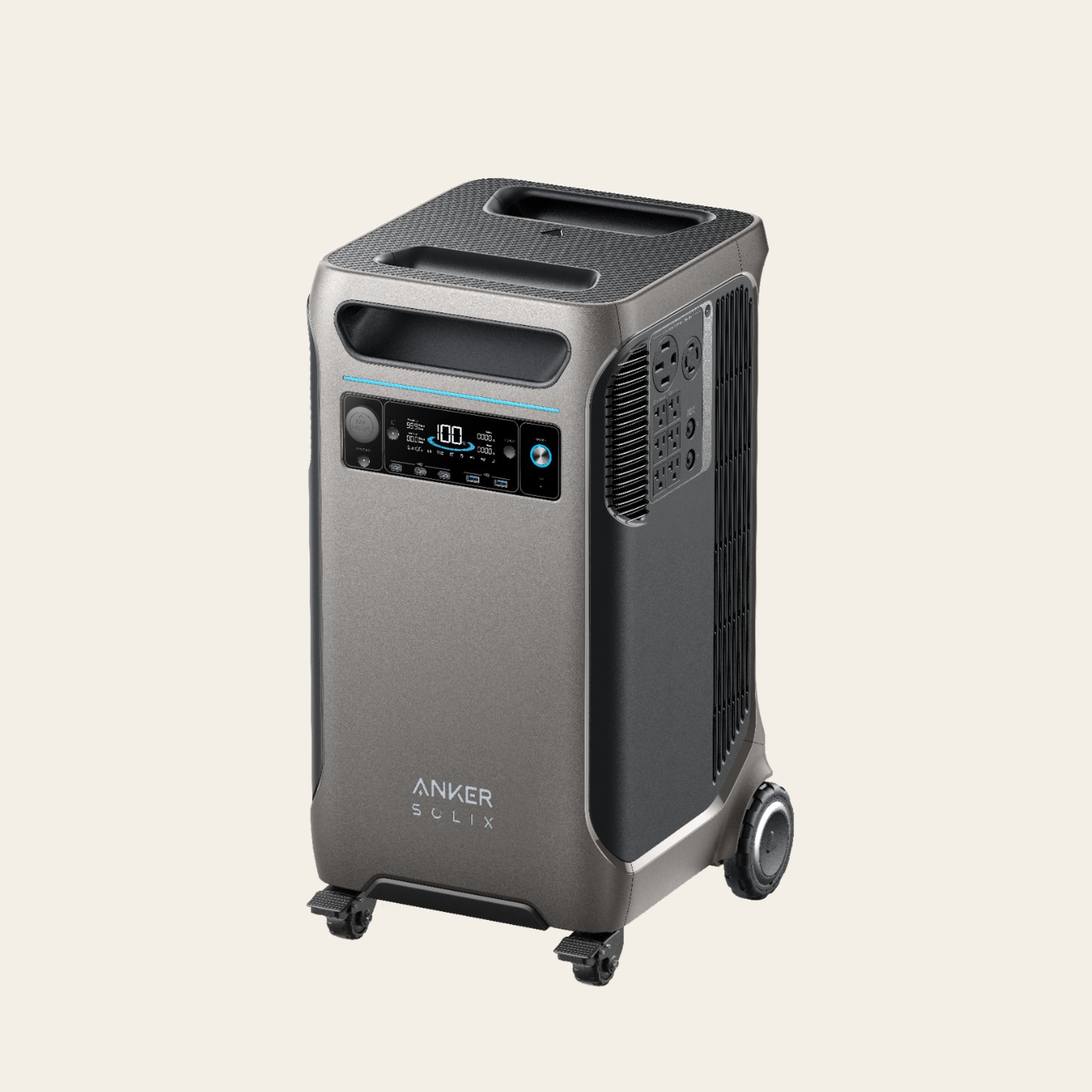
Best for 240 volts
Anker SOLIX F3800
3,840 Wh · 6,000 W · LFP
$2,199.98
Price checked Aug 26, 2026
That is the whole physics: a battery stores watt-hours before the storm, and a generator manufactures them for as long as the gas keeps flowing. Noise, permits, 240 volts, and winter are the details that follow. Match the physics to the outages your town actually serves, and this decision gets almost easy.
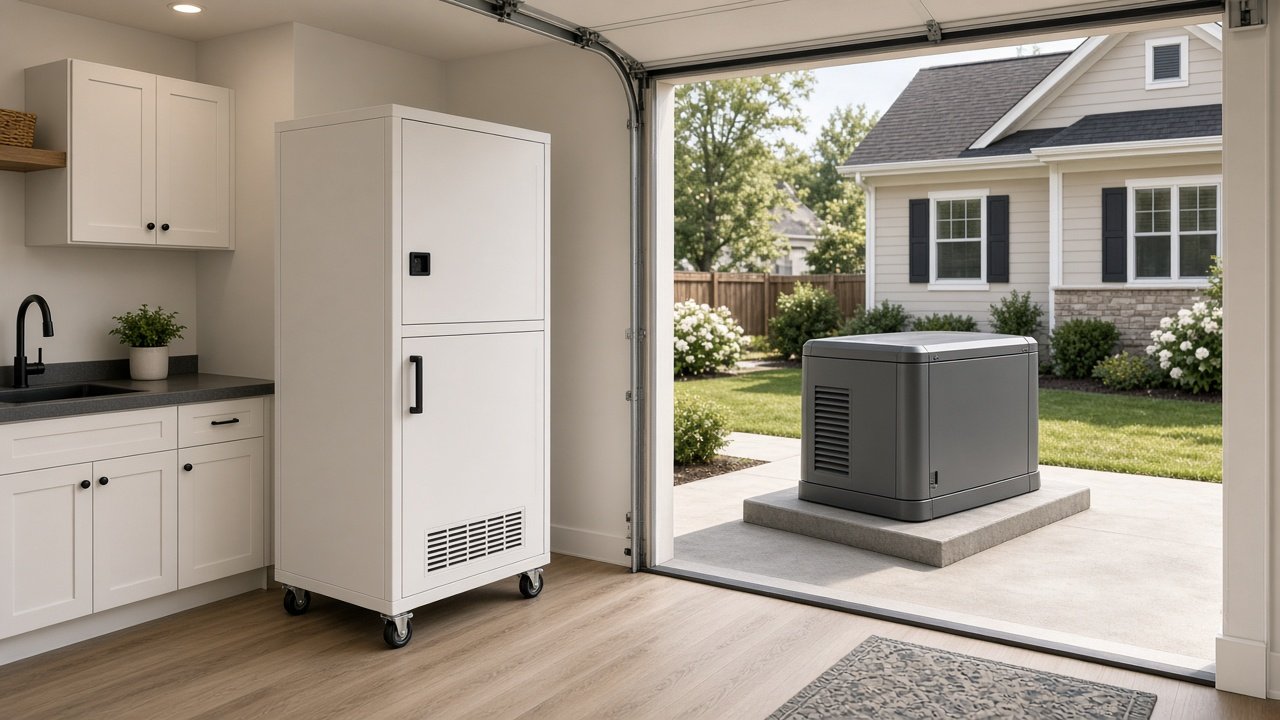

Both products get sold under the same “home backup” banner, An expandable battery is quiet, clean, and bounded: when the stored hours are spent, they’re spent. An automatic standby is loud, thirsty, and effectively endless while the fuel holds. Neither is the grown-up choice in general. One of them is the grown-up choice for your outage history, and that is the match this page makes.
The battery side here has machines we can link: the Anker SOLIX F3800 and the two 120-volt machines that grow (the BLUETTI AC200L and Jackery Explorer 2000 Plus). The generator side is pure information: our partners don’t sell engines, and we won’t invent a link to look better-stocked. Engine prices live at what a standby really costs. The engine category itself is here.
3,840 Wh · 6,000 W · LFP
$2,199.98
Price checked Aug 26, 2026
The F3800 arrives holding 3,840 watt-hours, and the kitchen translation is friendly: a cycling fridge sips one to two kilowatt-hours a day (closed fridge ~150 W, about a third of the time), the lights and the router are pocket change, and everyone’s fine deep into the weekend. The villain is heat. A 1,500-watt space heater drinks the whole tank in a couple of running hours, which is why battery plans come with sweaters. Extra modules stretch the tank. Not one of them connects it to a gas pipe.
A 10 to 12 kW standby on natural gas is a different animal: it keeps making watts overnight, in a blizzard, while you sleep, for as long as the utility gas holds and the engine was exercised. Propane is the same story with a gauge you own. (Gasoline stays with portables you babysit, never on a pad expected to wake itself.)
The battery’s substitute for fuel is recharge, and it is the honest weak leg. Wall power refills the tank quickly whenever the grid flickers back. Folding panels refill it at weather’s pace. A 200-watt folder returns something like half to a full kilowatt-hour on a decent day, and winter haze cuts that again. A multi-day ice storm with no sun is the scenario where battery math fails unless the module stack is tall and the load list is humble. Say that sentence out loud before you pick a side. It does most of the deciding for you.
| Expandable home battery | Automatic standby generator | |
|---|---|---|
| Energy | A finite tank: grow it with modules, refill from the wall or panels | Keeps coming as long as gas or propane flows |
| Power | Inverter-limited, and 240 V only on some machines. The F3800 gives 6,000 W steady, 9,000 W surge | Sized in kilowatts at the pad, whole-panel with the right transfer switch |
| Install | Can start as a plug-in box. Wall wiring means an electrician’s inlet or transfer switch | Pad, gas line, transfer switch, permit: a real little construction project |
| Noise & air | Fan hum, no combustion, so you can sleep in the same room as it | An engine with clearances, and the neighbors hear the weekly exercise |
| Winter | Cold trims solar recharge, the tank is still a tank, and heat is the costly ask | Fuel makes watts at midnight in the sleet, and starting and upkeep are the winter jobs |
| Cost shape | More dollars per stored hour, gentler install: F3800 at $2,199.98 on Aug 26, 2026 | Fewer dollars per kilowatt, heavier install: see the cost page |
| Where we link | Anker SOLIX · BLUETTI · Jackery | Nowhere: no invented engine links, ever |
Battery inverters hum like a desktop computer. Not silence, but the kind of sound you stop hearing. You can sit beside one all evening, which is exactly why people buy them for CPAPs and routers. You cannot sit beside a running standby, and no code officer will let you try. For apartments, tight lots, and light sleepers, that difference is the whole decision.
Carbon monoxide belongs to combustion, not batteries. A pad plant still needs its measured distances from windows and doors, and the weekly exercise run is how you and the neighbors negotiate the relationship before the storm instead of during it. If your HOA already wages war on outdoor equipment, note the honest framing: a battery is a smaller, bounded backup that may simply be the only legal option on your lot, which is sometimes all the decision you need.
A battery feeding extension cords is a consumer product, no paperwork attached. The moment you want wall outlets live during an outage, you’re in electrician territory (an inlet box with an interlock, or a listed transfer switch), and that’s money well spent. The dryer-outlet cheat cord stays banned on every page of this site: it can burn your service and hurt the lineworker fixing your street.
A standby is a permit from day one (pad, gas, transfer switch, inspection), which is precisely why install so often costs more than the machine. The battery path stays cheap while it stays portable, and becomes a project the day the fridge outlet itself needs to stay live. Either way, if wall wiring is the goal, the electrician is part of the product, and better priced before the invoice than after.
We’re writers, not your inspector, gas fitter, or HOA board, and all of them outrank us at your address. Confirm live specs and local rules before money moves. That is the plan.
Many wells, dryers, and air handlers run at 240 volts, and no stack of 120-volt modules ever reaches them. The AC200L at a full 8 kWh is still speaking the wrong language to your well pump. The battery that speaks it is the F3800: 6,000 watts steady, 9,000 surge, 120/240 V, 3,840 Wh, 132.3 pounds. Spec sheet says those figures, checked August 26, 2026. That surge number is Anker’s printed rating, and even so, a big motor’s first-second gulp deserves a real check. Owners keep saying household wells start when the numbers line up; electricians still add soft-starts for a reason.
Central air, electric ranges, and tankless electric water heaters remain engine problems or turn-it-off problems on any battery. Voltage only opens the door. Watt-hours decide how long you stay. A battery that can start the well can still spend itself keeping the pressure tank happy all day. Both numbers, always.
An ice storm examines both products at once: long nights, weak sun, and everyone reaching for the space heater that ruins battery math. The standby doesn’t care that the driveway is glazed. The folding panel sitting on that driveway very much does. So the honest sorting is regional. Three January days without power in a house that can’t lose heat: that is the engine, and it is not close. Eight hours a few times a year with doors closed and sweaters on: that is the tank, and it is not close either.
Cold also changes how lithium accepts a charge, so follow the maker’s temperature limits, and don’t store a 132-pound cabinet in an unheated shed expecting nameplate performance in a polar snap. LiFePO4 is the patient chemistry we prefer for this work. Patience is not insulation.
How we know: Specification analysis + category honesty. No install jobs measured on site.
Price check: anker-solix-f3800: $2,199.98 (checked 2026-08-26) (2026-08-26) — from merchant page / products.json; may change.
Limits: We did not run a hands-on lab on these units. Surge blanks stay blank where the maker never prints one clean figure. EcoFlow stays comparison-only (no hop). Disclosure mode is dormant — we do not claim commissions.
The flip condition, said once: outages measured in days with heat that can’t shed reverse every battery argument on this page. Buy the engine. Outages measured in hours reverse every engine argument. Buy the tank, and enjoy the quiet.
Battery links here go to Anker SOLIX, BLUETTI, and Jackery, and nowhere else. Nobody here ran a side-by-side winter on every machine. Specs are dated August 26, 2026 and read closely. The kit shortlist: the home batteries that grow · the deep dive: F3800 notes.
Engine class notes live at air-cooled versus liquid-cooled. And if reading this far revealed that you only ever needed the fridge covered, skip both heavy paths and read stations for home backup instead.