
BLUETTI SP200L: the panel whose paperwork we could finish
Of the three folders we name, the BLUETTI SP200L is the only one whose open-circuit voltage the maker prints plainly: 24.6 volts, right there on the page. That one honest number makes the wiring math something you can finish at the kitchen table, which in this category is quietly a luxury. 200 watts, 17.15 pounds, $399, and a cable meant for a BLUETTI input.

The short version
- The BLUETTI SP200L is the 200-watt folding panel with the figure its rivals here lack: a printed open-circuit voltage of 24.6 volts, alongside 17.15 pounds and $399 on August 26, 2026.
- Two panels in series roughly double that voltage.
- Whether your station's input can accept it is arithmetic you can actually finish with this panel.
- One cell stays blank: BLUETTI never prints a clean weather-sealing rating, so neither do we.
Best for BLUETTI owners
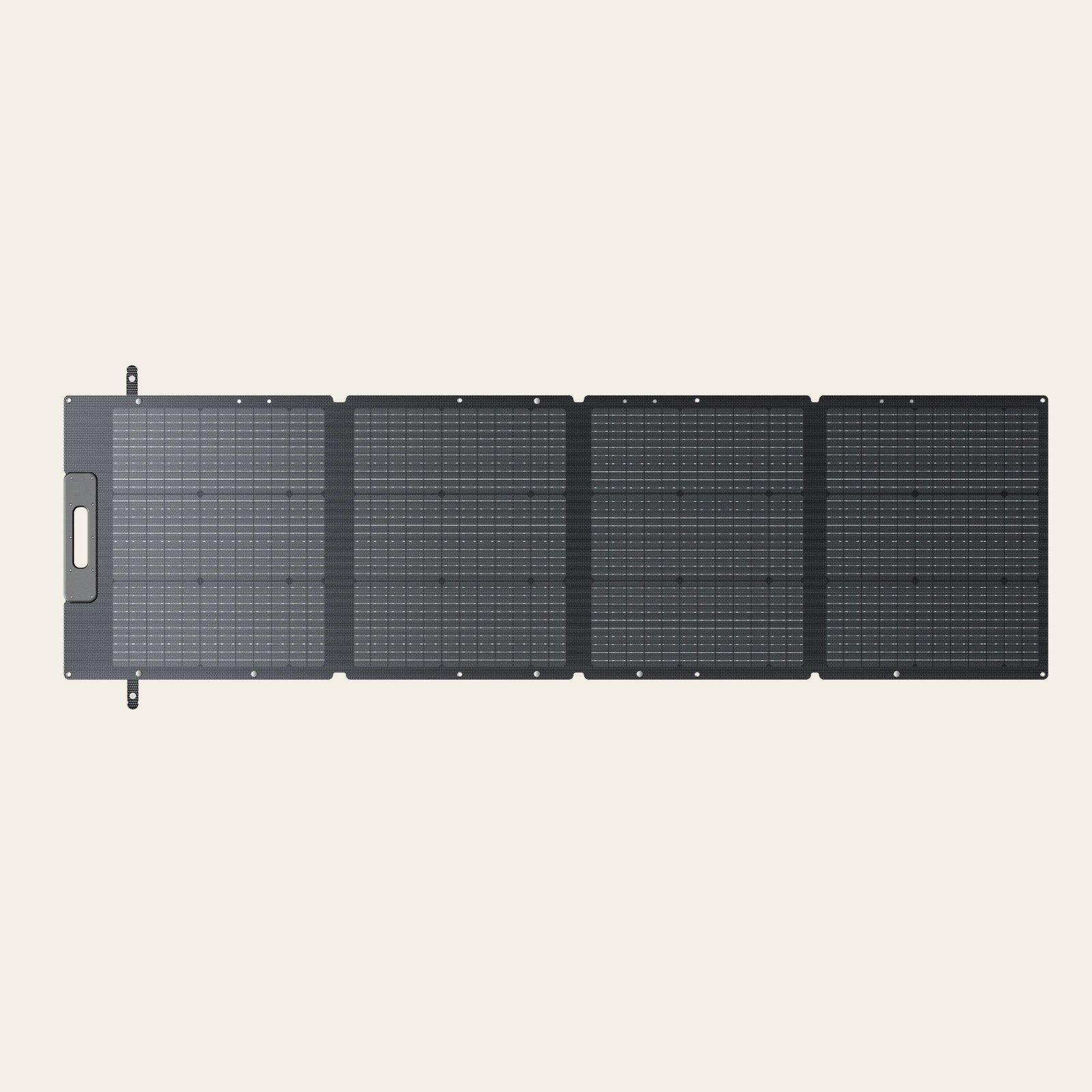
BLUETTI 200W Portable Solar Panel (SP200L)
The matched panel for the AC200L, and the only one whose open-circuit voltage the maker prints plainly.
$399
Price checked Aug 26, 2026
See BLUETTI 200W Portable Solar Panel (SP200L) on bluettipower.com, opens in a new tab
Here’s what endears this folder to me: the number that matters most in panel shopping, open-circuit voltage, the one that decides whether your charge controller lives a long and boring life, is printed plainly on BLUETTI’s page. 24.6 volts, no scavenger hunt. The rest as listed on August 26, 2026: full name “BLUETTI 200W Portable Solar Panel (SP200L),” 17.15 pounds, $399 with no crossed-out price beside it. It’s the BLUETTI-shaped answer to the SolarSaga: 2.82 pounds heavier, one crucial number more honest, and one sealing rating shyer.
Who this fits
- You’re a BLUETTI home, the AC200L especially, and you want the cable that was designed for that input.
- 17.15 pounds is a carry you’ll happily repeat on every sunny outage morning.
- You appreciate a voltage you can actually check against the station’s maximum before any second-panel ideas.
- 200 watts of honest daylight is the job, not a 35-pound, 400-watt project.
Who should skip
- Your station is a Jackery. Start with the SolarSaga 200W and its click-in cable.
- Your station is an Anker and you want the big in-family folio. That’s the PS400, if you’ll truly carry it.
- You need a printed weather-sealing rating from us. BLUETTI never gives a clean one, so we can’t hand you one.
- You wanted rooftop production. Different product, different site.
How we know: Specification analysis.
Price check: bluetti-sp200l: $399 (checked 2026-08-26) (2026-08-26) — from merchant page / products.json; may change.
Limits: We did not run a hands-on lab on these units. Surge blanks stay blank where the maker never prints one clean figure. EcoFlow stays comparison-only (no hop). Disclosure mode is dormant — we do not claim commissions.
200 watts, 24.6 volts, 17.15 pounds
The daylight math is the same friendly arithmetic as any 200-watt folder: plan on somewhere between half and a full kilowatt-hour on a decent day. That’s a real dent in the AC200L’s 2,048 Wh tank by late afternoon, aimed and un-shaded. January haze pays less. A bright June noon pays more. The spec sheets never mention the napping-fridge half of the equation. The door stays closed, the tank stretches, everyone wins.
Now the number worth savoring: 24.6 volts open-circuit, printed. That means you can do the series math honestly. Two panels in series sit near 49.2 volts before the cold-morning rise, and if your station’s maximum is anywhere close to that figure, you have no margin and shouldn’t pretend otherwise. Parallel wiring holds the voltage near 24.6 and stacks current instead, which moves the homework to wire gauge and the input’s current limit. Different homework, still homework, and all of it possible because BLUETTI wrote the number down in the first place.
The carry is 17.15 pounds. A one-person folio, one trip, no ceremony. Price that day: $399. See tonight’s price at BLUETTI →. Same price to you either way, disclosure here.
- Write down your BLUETTI station’s solar window (maximum watts and maximum voltage) from the live page.
- Set 24.6 V against it, plus cold-morning margin. If series math crowds the ceiling, one panel is the answer, and a fine one.
- Use the intended MC4 path, the connector BLUETTI actually meant, rather than a marketplace adapter as plan A.
- Aim, watch the wind, fold before hail. The kickstands are helpers, not anchors.
The sealing rating we left blank
Jackery prints IP68 on the SolarSaga. Anker prints IP67 on the PS400. BLUETTI’s page for this panel never commits to one clean code, so our cell is a dash. Let me say precisely what that dash means, because blank cells invite imagination. We are not calling the panel fragile, and we are not quietly filling in IP67. We won’t guess on your behalf. Keep it out of standing water, don’t read an empty cell as a diving certification, and you’ll be exactly as fine as physics allows.
The matched panel for a BLUETTI home, with the one voltage in this category you can actually plan around. The hard-case alternative shape lives at folding vs briefcase, still with no invented briefcase model, because no maker gave us a clean photo of one.
Second-panel wisdom, offered gently
One SP200L is the default, and a lovely default. Two is a wiring project you ought to be able to describe in a single sentence: series for voltage, parallel for current, station limits governing both. If that sentence won’t come, stop at one panel. A Y-cable from a marketplace tab is not a blessing from BLUETTI, however confident its listing photos look.
Driveway manners are the usual: leaves and puddles subtract, kickstands skate on wet concrete, and your own house’s 3 p.m. shadow will steal yield you’ll be tempted to blame on clouds. Bring the kit in when you leave the house. At 17.15 pounds it’s exactly light enough to make that the easy habit rather than the skipped one.
And a scale note for the ambitious: the AC200L’s famous 8,192 Wh ceiling is a battery figure. This panel remains a 200-watt daylight figure no matter how many modules the tower gains. If your honest scenario is sunless ice for days, what you needed was watt-hours or an engine, not a second folio you can’t aim at a sky that isn’t there.
- 200 W of daylight · 24.6 V printed · 17.15 lb.
- $399 on August 26, 2026, no strikethrough shown.
- Weather sealing: a dash, because we won’t invent it.
- MC4 into a BLUETTI input. Do the series math before panel two.
- Pairs with the growing 120-volt machines, not with anyone’s roof.
What we’re not claiming
No year-long yield log behind this page. This is the dated sheet plus the job it fits, read closely. Specs dated August 26, 2026. Method: how we work · the shop: BLUETTI · the shortlist: the panels worth unfolding.
A Jackery station flips this buy to the SolarSaga, and so does needing a printed sealing rating (IP68, in writing). But for a BLUETTI home, a pleasant carry, and arithmetic you can actually finish, this is the folder. The homework: panel buying guide · the category: portable solar panels · the stations: power stations · corrections: contact.