Read your station’s solar input before you fall for a wattage sticker
This is the category where people fry charge controllers, or wonder why a “400 W” folio delivers 90 on a gray morning. Buy in this order: the station’s window first, then Voc, then watts against your real sun, then the weight you’ll truly carry.
We buy nothing on your behalf and take no payment for a good word. Prices carry the day we checked them.
The short version
You buy a portable solar panel once, and you find out whether it was the right one on the first sunny morning of an outage.
This guide walks the buying order that keeps that morning calm: the station's solar input window, open-circuit voltage, honest watts, and the weight you'll actually carry to the driveway.
Ten minutes here can spare you a dead charge controller later.
Method: how we pick · disclosure. Spec-based unless a photo of the unit in our hands is shown.
Affiliate disclosure: Some links below are affiliate hops. If you buy after clicking, The Home Backup may earn a commission at no extra cost to you.
A portable panel is an accessory to a station, not a miniature utility. If you don’t own the battery yet, start at the power station buying guide and come back. And if you were picturing rails on a roof, you’re in the wrong category entirely. Rooftop solar is out of scope on The Home Backup.
Read the station’s solar input window. Max watts, max Voc, sometimes max Isc. Write the numbers down. Cold sun raises Voc, so leave yourself margin.
Prefer the same-brand cable. SolarSaga into Jackery, SP200L into BLUETTI, PS400 into SOLIX.
Size watts to the job, using dull daily kilowatt-hour guesses, not nameplate times eight.
Count packed weight as a carry across your own driveway, not as a spec-sheet line.
Plan for theft, hail, and wind on the same page as connectors.
If you need more than one panel, decide series vs parallel before you buy Y-cables.
Decision strip
How much panel do you need? Match daylight to the tank with the load calculator, then confirm Voc on the live station page before any series cable. Product example: Anker SOLIX PS400 (shop hop).
Voc versus the station window
Open-circuit voltage is what the panel produces with nothing plugged into it, and it runs highest exactly when the day looks its best: cold cells, bright sun. Your station’s charge controller lists a maximum. Go over it and you’re in repair-or-replace territory, on the very morning you needed the thing to work. This is the one spec we refuse to guess.
As of August 26, 2026, the BLUETTI SP200L lists a Voc of 24.6 V. The Jackery SolarSaga 200W and the Anker SOLIX PS400 carry a dash instead, because their makers’ pages never settle on one figure, and we didn’t pick a reseller’s number or split the difference between two charts. You’ll need to read the live panel page and the live station page together, on the day you buy. If you can’t find a Voc you trust, don’t series-wire, and think hard before you buy at all.
Margin matters more than it feels like it should. A panel that’s fine at 25 °C may not be fine at 0 °C, and stations list a watt ceiling too. A 400 W nameplate feeding a 200 W input isn’t a bargain, just extra glass to carry. Check the volt window and the watt window both.
A dash in the Voc column is an honesty move, not a missing feature on the product. It marks a number we wouldn’t invent. Details on that rule: how we work.
Watts versus sun
The number on the box assumes a defined irradiance, usually 1,000 W/m², and a cell temperature your driveway will never hold. Winter, haze, a low sun angle, dirty glass, anything short of near-perpendicular: they all take their cut. A 200 W folder in decent sun might hand you somewhere between 0.6 and 1.2 kWh over a day, which is a useful top-up for a station around 2 kWh. What it will never be is 200 × 8 = 1,600 Wh. That math only works in the ad.
Keep the jobs straight, too. Getting the fridge through the night is a battery problem. The panel is asleep at exactly the hour you need it. A three-day event with midday sun is where a panel earns its price, and a four-hour evening outage never justifies a 35.3 lb folio. Clouds can cut yield roughly in half, sometimes worse, and shade creeping over one cell can crater a whole string. Don’t park the panel in the shadow of your own house and then blame the brand.
And the window trick, leaning the panel against the glass from inside, is a demo rather than a plan. Laminated glass reflects, and the angle is nearly always wrong. If the only sun you have comes through a pane, you don’t have a solar plan yet. That is fine. Now you know before spending.
Weight you will actually carry
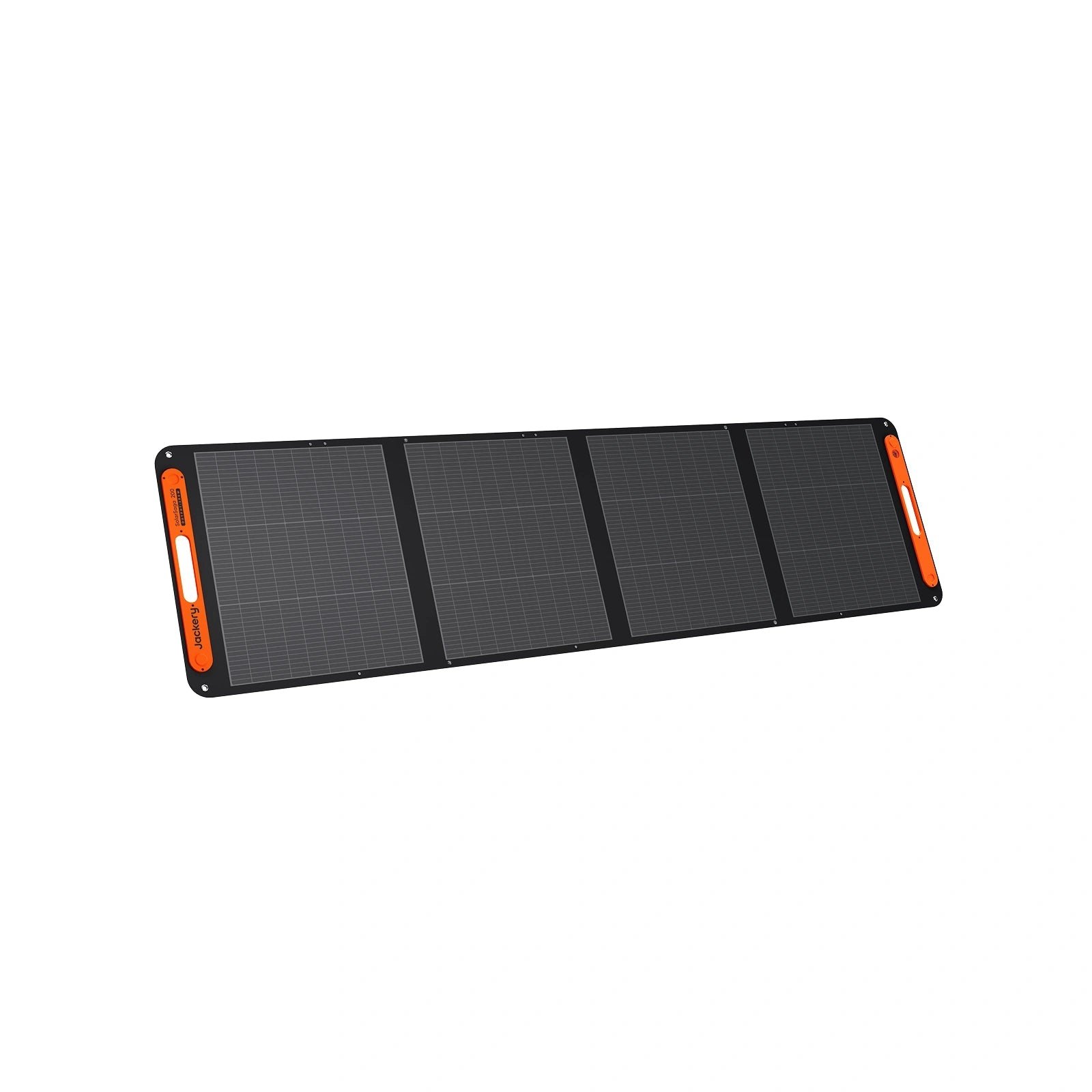
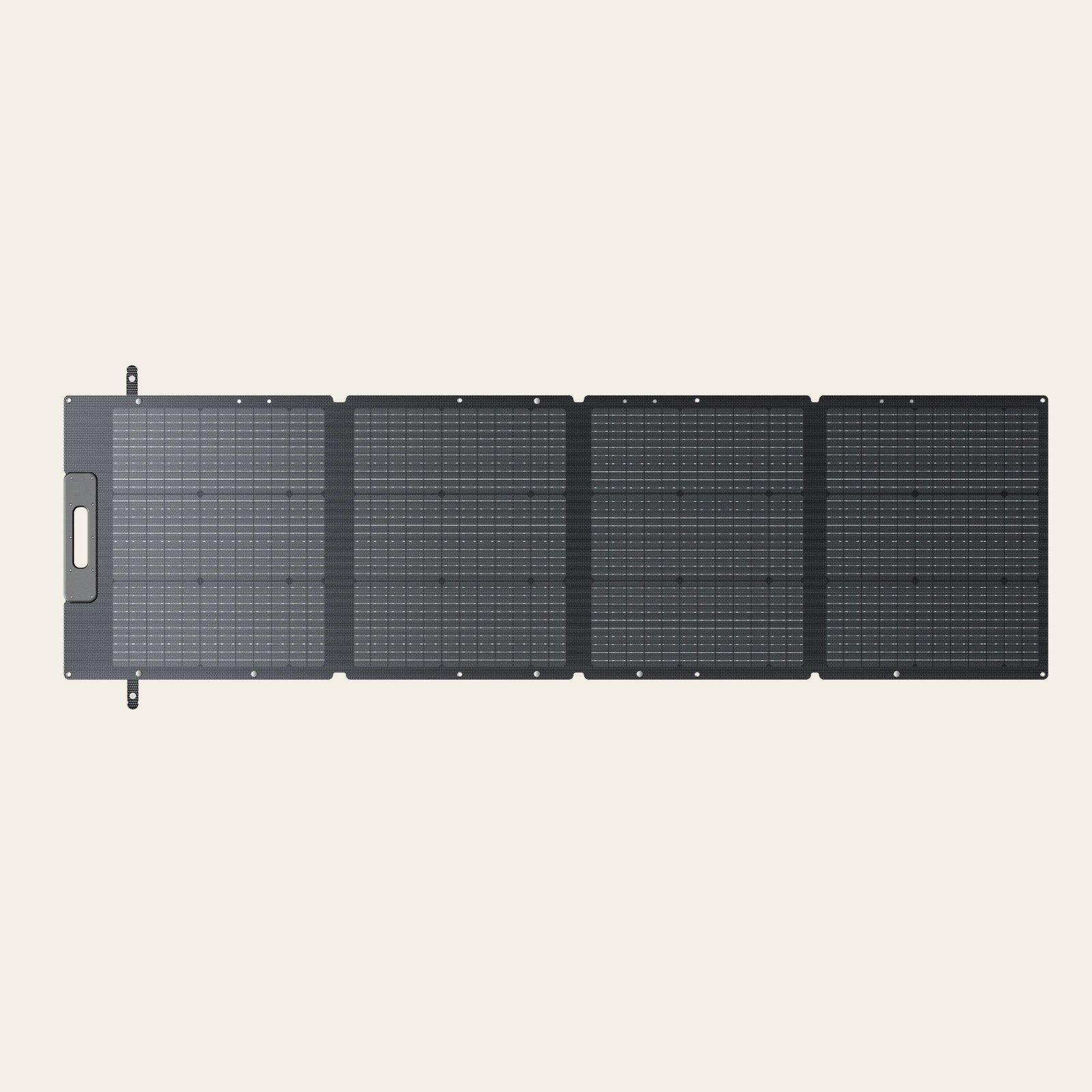
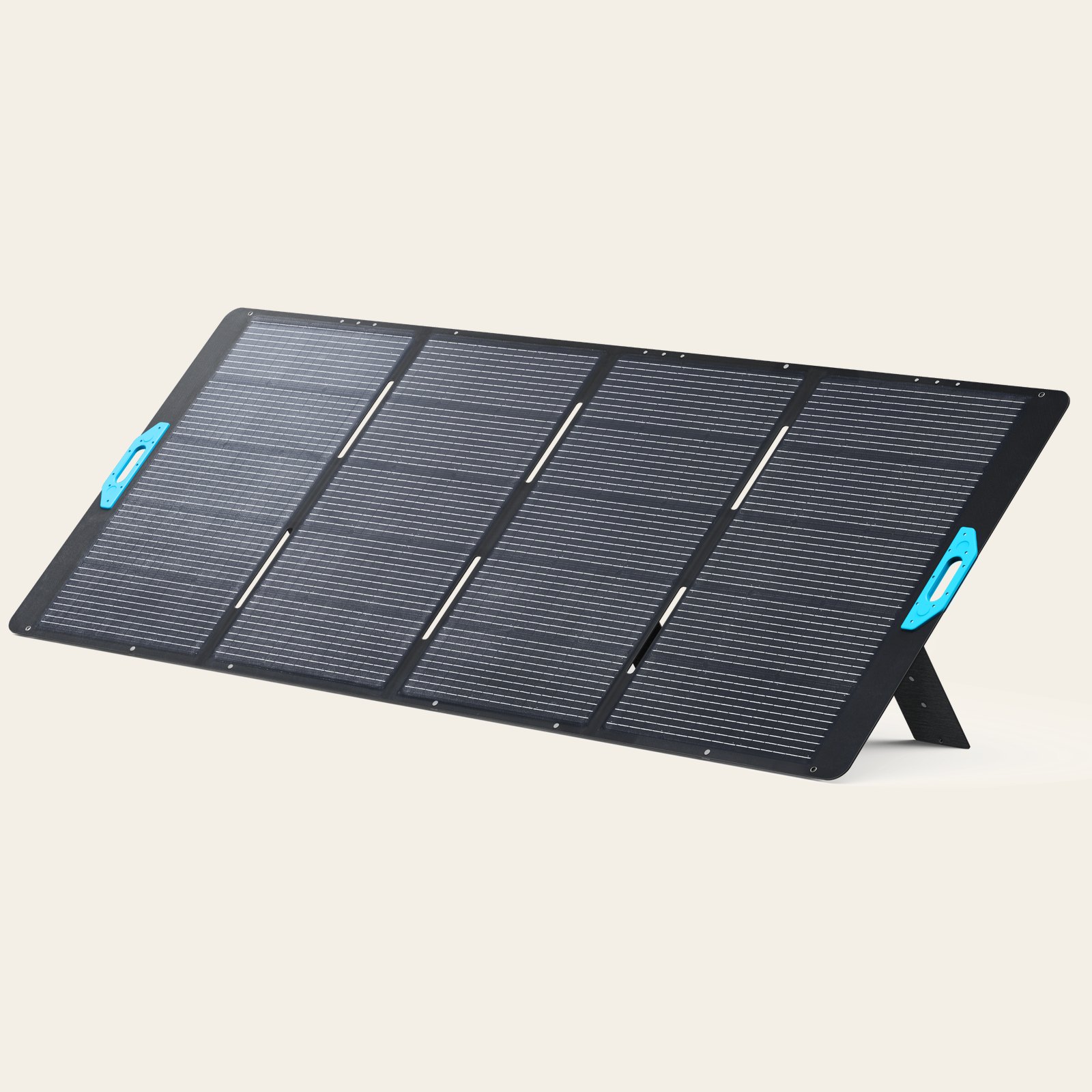
Jackery lists the SolarSaga 200W at 14.33 lb. BLUETTI lists the SP200L at 17.15 lb. Anker lists the PS400 at 35.3 lb. Those three numbers, more than any wattage, decide whether the kit ever leaves the garage, because you’ll be carrying it over wet concrete, in a hurry, probably before coffee. Two 200 W folders plus stands and cables is already a project. One PS400 is 35.3 lb in a single grab. Be honest with yourself about that before you chase 400 W on paper.
Weight and kickstands are one conversation. A heavier folio holds steadier in a breeze right up until it doesn’t, and then it is a bigger thing to chase across the driveway. If the honest answer is that you won’t carry it, buy the lighter 200 W class. Or skip panels altogether and put the money into watt-hours. Either answer is fine. Pretending is the expensive one.
Theft and weather
An unfolded panel is expensive, visible from the street, and awkward to lock. A gift to anybody with a van. Bring it in when you leave, and bring it in before hail. IP68 on the SolarSaga and IP67 on the PS400 are water-and-dust ratings, not hail insurance and not a theft rating. The SP200L’s IP cell carries a dash because BLUETTI’s page never gives one clean rating, and we won’t pencil in IP67 to make the table look finished.
Wind is the other weather. Those folding leaves are sails, and gusts find them. Guy-line if you must, babysit if you can, and fold up when the gusts win. Running on battery until a front passes is the plan working. A wet autumn driveway with leaves down is the realistic picture.
Do not leave four figures of glass unsupervised on a public-facing lot.
Do not treat an IP rating as a hail warranty.
Do not run a cable across a dark stoop without tape and a plan.
Do not aim at a puddle mirror and call it extra irradiance.
Series versus parallel
Series wiring stacks voltage. The string’s Voc is roughly the sum of each panel’s, plus the cold-weather rise, and that is exactly how people over-volt a station that would have been perfectly happy with one panel. Parallel keeps the voltage near a single panel’s and stacks current instead, which moves the risk to connectors, wire gauge, and the station’s current limit. Different homework. Still homework.
If you can’t say which one you’re doing, buy a single matched panel first. If you later add a second SolarSaga, SP200L, or PS400, read the station manual for the approved topology before anything else. A Y-cable from a marketplace tab is not a design review, and MC4 connectors aren’t a personality. They’re a way to make a mistake look professional.
Product photographs are the manufacturers’ own studio shots, used as supplied. Specifications and prices come from their US product pages, checked August 26, 2026.
SolarSaga 200W into a Jackery station. The lightest named folder (14.33 lb), IP68, $379 / was $429. Voc blank, so confirm on the live page before any series pair. The natural partner for the Explorer 2000 Plus. Notes: SolarSaga 200W.
SP200L into a BLUETTI station. 17.15 lb, 24.6 V Voc (listed), $399, IP blank. The natural partner for the AC200L. Series two only if 24.6 plus 24.6 plus cold margin still sits under the station’s max. Notes: SP200L.
PS400 into an Anker SOLIX station. 400 W nameplate, 35.3 lb, IP67, $699.99, Voc blank. Confirm the solar watt ceiling on the C2000 Gen 2 or the F3800 first, so you aren’t buying glass the input will clip. Notes: PS400.
Unfold a panel if
You’re pairing a first folding panel to a Jackery, BLUETTI, or Anker SOLIX station.
You were tempted to series-wire “for more volts” without a Voc budget.
You will weigh 35.3 lb in your hands before clicking 400 W.
Skip the glass if
You want set-and-forget roof production. Out of scope.
You have no station yet and no plan to buy one.
Your outages come at night. Buy watt-hours instead, over at power stations.
Sources
Manufacturer US pages for SolarSaga 200W, SP200L, and PS400 (Voc where printed, watts, weight), dated on this guide.
Station solar-input windows from the paired Jackery / BLUETTI / Anker SOLIX product pages — confirm live before series-wiring.
Prices only when named: from dated checks / products.json; blanks stay blank.
How we evaluated this (and what we did not do)
This guide is decision content. Panel watts and Voc figures are maker-page values on dated checks, not our field logger. Example products with buy intent carry /go hops. disclosure · how we review.
Honest caveats
No-name blankets that over-Voc a Jackery input are not featured. We don’t have a named briefcase SKU with an official photo, so the format notes live on folding vs briefcase. Specs dated August 26, 2026. Disclosure.
Rankings, if you’re ready for the cart: best portable solar panels. Hub: portable solar panels. Before any of it, copy your station’s max Voc and max solar watts onto a piece of tape on the case. That tape is the whole buying rule.