
Jackery SolarSaga 200W: the folder you’ll actually unfold
The Jackery SolarSaga 200W is the lightest panel in our catalog at 14.33 pounds. That’s a one-hand carry to the driveway, a cable that clicks straight into a Jackery station, and sealing Jackery actually prints (IP68). One cell in its table is a dash, on purpose, and knowing why is worth two minutes of your time.

The short version
- The Jackery SolarSaga 200W is the 200-watt folding panel built to refill a Jackery station in daylight: 14.33 pounds, sealed to IP68, $379 (listed at $429) on August 26, 2026.
- One spec is deliberately missing.
- Jackery's own pages never agree on the panel's open-circuit voltage, so our table shows a dash instead.
- What that dash means before you series-wire is most of this page, and it's the part that protects your hardware.
Best overall
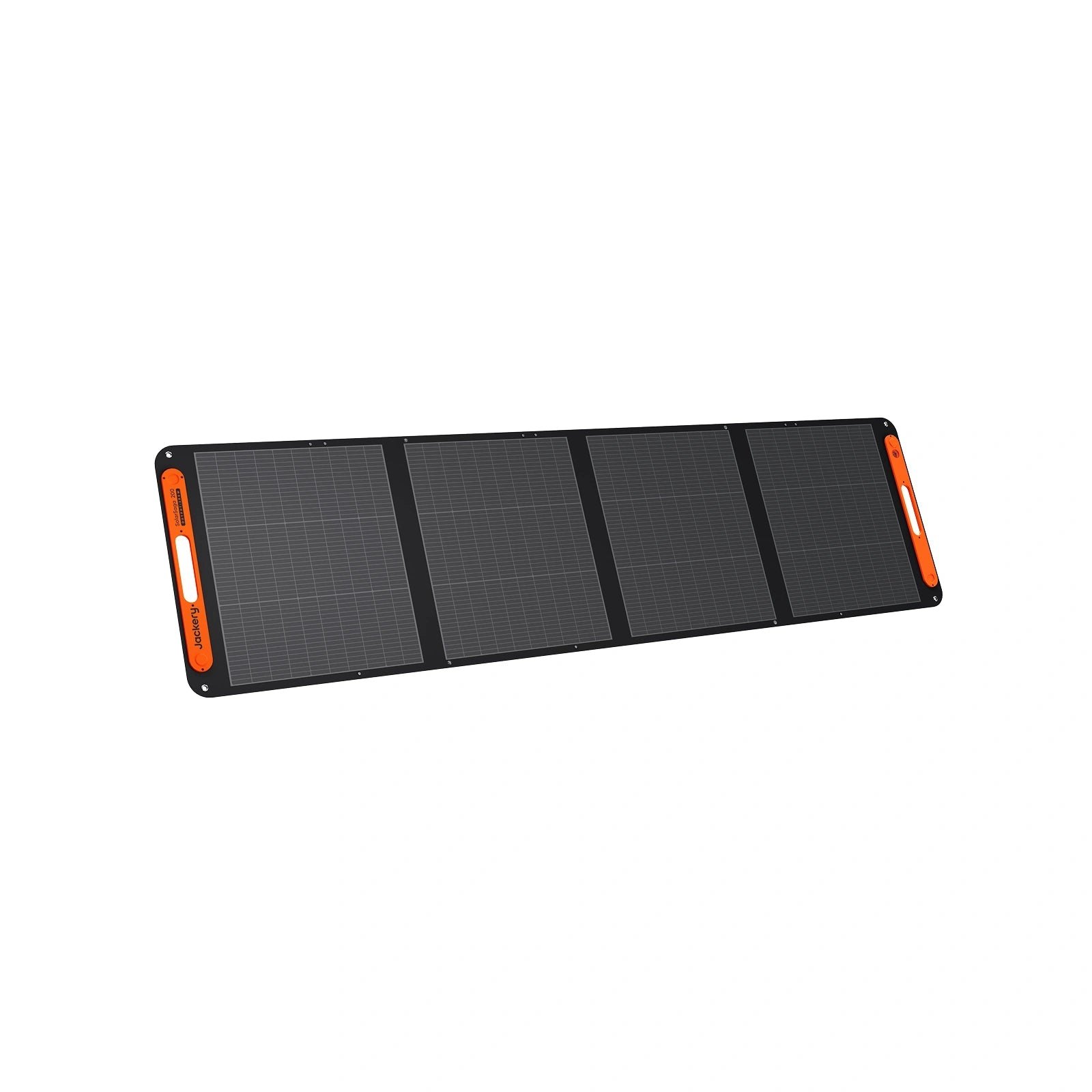
Jackery SolarSaga 200W
The lightest folder here, and the cable clicks straight into a Jackery station with no adapter to hunt for.
$379 $429
Price checked Aug 26, 2026
See Jackery SolarSaga 200W on Jackery.com, opens in a new tab
Three numbers tell you most of the story: 200 watts of daylight, 14.33 pounds in your hand, and IP68 sealing, all of it from Jackery’s own page, August 26, 2026, alongside a $379 price (listed at $429 before the sale). A fourth number is famously absent: the panel’s open-circuit voltage, which Jackery’s pages never settle on. Our table shows a dash there, and the dash is doing honest work. I checked, because you’d want to know.
Who this fits
- You own a Jackery station, or you’re about to, the Explorer 2000 Plus above all, and you want the cable that just clicks.
- A 14-pound carry and a couple of aim adjustments a day sounds like a pleasant outage morning, coffee in the other hand.
- You like sealing ratings the maker actually prints: IP68, in writing.
- You’ll fold it before hail and before errands. Thirty seconds, both times.
Who should skip
- Your station is a BLUETTI or an Anker. Stay in the family with the SP200L or PS400 and skip the adapter drawer.
- Your outages arrive after dark. Watt-hours cover nights. Glass doesn’t, and it never will.
- You wanted set-and-forget roof production. Different product, different site.
- You were planning to series-wire without a voltage you trust. We don’t have one to hand you, and that’s this page talking.
How we know: Specification analysis.
Price check: jackery-solarsaga-200w: $379 (list $429) (checked 2026-08-26) (2026-08-26) — from merchant page / products.json; may change.
Limits: We did not run a hands-on lab on these units. Surge blanks stay blank where the maker never prints one clean figure. EcoFlow stays comparison-only (no hop). Disclosure mode is dormant — we do not claim commissions.
Watts, weight, and that IP68
The 200 on the box is a laboratory number: perfect light, cool cells. A wet November driveway holds neither. The honest planning band for a folder like this is somewhere between half and a bit over a full kilowatt-hour on a decent day, which is a genuine dent in a 2 kWh station by dinnertime. Dirty glass, a low winter sun, and shade wandering across one corner all take their cut. Expect that, and let a June noon surprise you.
The weight is the quiet star. At 14.33 pounds this is the panel that actually leaves the garage. The telling detail: you can carry it in one hand with coffee in the other, which is precisely how outage mornings go. And IP68 is Jackery’s printed sealing rating: water and dust, honestly covered. Hail, theft, and a kit left in a gutter are still on you. No rating covers those.
The price that day: $379, with $429 shown beside it. Sales move. The strikethrough is what the page showed that day, not a promise it comes back. See tonight’s price at Jackery →. Same price to you either way, disclosure here.
- Look up your station’s solar input window (maximum watts and maximum voltage) on the live Jackery page, and write both down.
- Don’t borrow a voltage from a forum or a reseller where Jackery’s own pages disagree. That’s exactly why our cell is a dash.
- Unfold, kickstand, aim as close to square-on as you’ll honestly maintain. Twice before lunch is plenty.
- Fold before hail, wind, and errands. Future-you says thanks.
The voltage we won’t invent
Open-circuit voltage is the number that decides whether a panel and a station get along, and it matters most the moment you consider wiring two panels in series, which roughly doubles it. Jackery’s pages never agree on this panel’s figure, so our tables show a dash rather than the larger of two conflicting charts. Read the live panel page and the live station page together on the day you buy.
Until then, the conservative topology is also the pleasant one: one matched panel into the intended Jackery port, no series experiments. Cold, bright mornings push voltage up. The best solar day of the year is exactly when that margin matters. The full lecture lives in the panel buying guide.
The matched folder for a Jackery home. Unfold it with your coffee, aim it twice, fold it before the weather turns. Curious about the hard-case shape instead? Folding vs briefcase compares the formats (we name no briefcase model, because no maker gave us a clean photo of one).
A good driveway day
Set the folio where the afternoon shade won’t creep across it. One shadowed corner drags down the whole panel’s output, which feels deeply unfair and is simply how strings work. Route the cable where nobody trips, skip the through-the-window demo (laminated glass eats more than you’d think), and bring the kit in when you leave the house, the way you would a bicycle.
Scale your hopes to the tank: the Explorer 2000 Plus holds 2,042.8 Wh, and one 200-watt folder won’t refill that by lunch in January. Aimed at a June noon, though, it puts back real, cheerful numbers. Extra Battery Pack modules deepen the tank without speeding up the refill. If you need more daylight than 200 watts, the honest options are a second SolarSaga (voltage homework first) or another family’s 400-watt folio at a weight you must genuinely mean to carry. The PS400 is Anker’s panel, not a Jackery accessory, and we won’t dress it up as one.
- 200 W of daylight · 14.33 lb · IP68, printed.
- $379 that day ($429 listed), August 26, 2026.
- Voltage: a dash here. Confirm it live, and never series-wire on a guess.
- Made for Jackery stations, happiest with the Explorer 2000 Plus.
- Daylight only. The nights belong to the battery.
What we’re not claiming
Nobody here has logged a year of sunshine on this folio. This is the dated spec sheet plus the job it fits, read carefully. Method: how we work. The shop: Jackery.
A BLUETTI or Anker station flips this buy to the SP200L or the PS400. Night-only outages flip it to watt-hours and no panel at all. But for a Jackery home, and for a carry you’ll actually make, this is the folder. Shortlist: the panels worth unfolding · the solar category · corrections: contact.