
Can a solar generator run a well pump? Read the label first
Most portable solar generators can’t run a typical deep well pump. Two exceptions are real, though, and the plate on your pump tells you which house you live in.
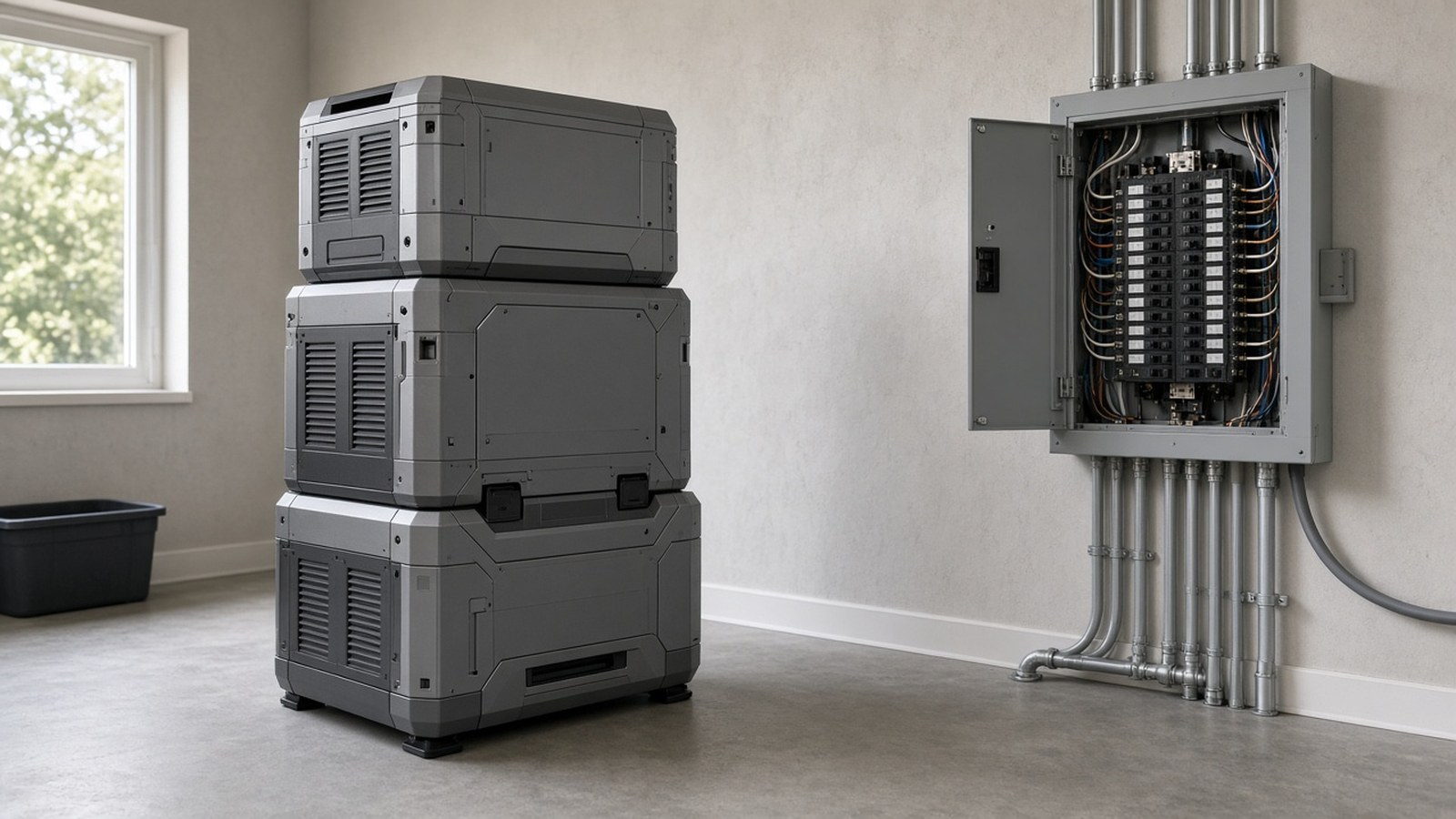

Short answer: most portable solar generators can’t run a typical deep well pump. Deep well pumps are very often wired for 240 volts (check yours below), and most portable power stations only put out 120 volts. No amount of battery fixes a voltage mismatch. Two exceptions are real, though. A 120 V shallow well or jet pump can run on a mid-size station if the numbers on its label fit. And a 240 V pump has one portable route worth a look, a station that puts out true 240 V split-phase power. Everything else on this page is about telling which house you live in. The wet-basement cousin of this question lives on the sump pump page.
Go read the pump’s own label
Before shopping, take a flashlight to the pressure tank or well house. You’re looking for a metal plate or sticker on the motor, or on the control box if your pump sits down in the well. Three numbers matter.
- Volts. It’ll say 115, 120, 230, or 240, or “115/230” if the motor can be wired either way. If your pump is down the well, its breaker in the panel tells the same story: a double-wide, two-pole breaker means 240 V. A single skinny breaker means 120 V.
- Amps. Sometimes printed as FLA (full-load amps), sometimes as “max load” or SF amps. That’s the running draw.
- Horsepower. Usually 1/2, 3/4, 1, or 1 1/2 HP. Horsepower matters because starting draw scales with it, and starting is where portables lose.
If a dual-voltage motor is wired for 230 V (the Red Lion jet pump manual says its dual-voltage motor ships set to 230 V), rewiring it to 115 V is a job for an electrician, not a Saturday guess.
Running watts versus starting watts
Here’s the math, done with makers’ printed numbers only. Volts times amps gives a ceiling for the watts; the true figure can run a little lower, so treat these as upper bounds.
A 120 V jet pump. Red Lion’s RJS-50-PREM, a 1/2 HP shallow well jet pump, prints 11.8 amps at 115 V. Multiply 115 × 11.8 and you get about 1,357 watts running. Its 1 HP sibling, the RJS-100-PREM, prints 17.6 amps at 115 V, which comes to about 2,024 watts. Red Lion doesn’t print starting amps for these pumps, so the spec sheet goes quiet on the one number you most want.
A 240 V submersible. Franklin’s published motor data for its 1 HP, 230 V, 2-wire 4-inch motor lists 10.4 amps and 1,600 watts at maximum load, and 48.7 locked-rotor amps. Locked-rotor amps are what the motor pulls for the first instant before it spins up. Multiply 230 × 48.7 and that first gulp is roughly 11,200 volt-amps.
That gulp is why a pump that “only” uses 1,400 or 1,600 watts running can still trip a station that’s rated well above that.
Franklin’s installation manual gives a useful yardstick. Its minimum generator table lists 4 kW for a 1 HP 3-wire motor and 6 kW for a 1 HP 2-wire motor (2-wire motors start without a separate control box). A 1/2 HP 2-wire motor gets 3 kW in the same table. That table was written for engine generators, not battery inverters, so think of it as a floor for the job, not a promise. To put your own plate next to the fridge and the furnace fan, use the load calculator.
The 240 V pump: the honest no, and the one portable yes
If your label says 230 or 240 V, a 120 V-only station can’t run it. Not a small one, not a big one, not two daisy-chained with a cheap adapter. The answer is no.
The portable route is a station with a real 240 V split-phase output. The Anker SOLIX F3800 is the one we point to. Anker’s spec sheet lists 6,000 W continuous at 120 V and 240 V, 9,000 W surge, 3,840 Wh of LFP capacity, and 240 V outlets on a NEMA 14-50 and an L14-30. Against Franklin’s yardstick, 6,000 W meets the 6 kW floor for a 1 HP 2-wire pump and clears the 4 kW floor for a 1 HP 3-wire one.
If your pump is 240 V, 1 HP or smaller, and you’re ready to wire a transfer switch, this is the portable machine whose printed numbers reach the job, with the fences below. Price: $2,199.99 with a code that expires January 1, 2027 (base price $2,299.99), in stock on ankersolix.com when checked October 15, 2026.
We buy nothing for you and sell nothing ourselves, and we are not earning commissions from these brands today; the store links below go to the maker’s own catalog. Check today’s F3800 price at Anker SOLIX
Now the fences. The 1 HP motor’s locked-rotor figure (about 11,200 volt-amps) is above the F3800’s 9,000 W surge rating, so a start is not guaranteed, and a 1 1/2 HP 2-wire motor (7.5 kW by Franklin’s table) is past it. Anker also notes the 240 V output can’t be used while the unit charges from 120 V wall power. Connecting it to a well circuit runs through a transfer switch or inlet, which means an electrician.
Where a mid-size station can work (120 V pumps)
Back to the other house. If your label says 115 V and 1/2 HP, a mid-size station is in range, with honest caveats.
The Jackery Explorer 2000 v2 prints 2,200 W continuous and 4,400 W surge on its 120 V outlets. Against the RJS-50-PREM’s roughly 1,357 running watts, that leaves headroom, and the surge figure clears Franklin’s 3 kW yardstick for a 1/2 HP 2-wire motor. That’s the best fit on this page for a 120 V shallow well. Price: $899 for the unit on jackery.com, orderable, checked October 13, 2026. Check today’s Explorer 2000 v2 price at Jackery
The BLUETTI AC180 prints 1,800 W continuous. Its 2,700 W figure is a Power Lifting mode BLUETTI describes for heating loads like kettles and space heaters, not a motor start rating, and the page we read prints no surge number for motors. So it covers the 1/2 HP pump’s running draw, but a hard start is an open question. A 3/4 HP jet pump (14.4 amps at 115 V, about 1,656 watts) would leave almost no room. A 1 HP jet pump, at about 2,024 watts running, is over the AC180’s line before it ever starts. Price: $499 on bluettipower.com, orderable, checked October 13, 2026. Check today’s AC180 price at BLUETTI
In every case here, the running load is the easy part. The start is the test.
When a portable is the wrong tool
Be straight with yourself about these:
- Your pump is 1 1/2 HP or bigger on 240 V. The math runs past every portable here. Look at a home battery wired into the panel, or a standby generator sized by your pump installer.
- You can’t wire a transfer switch. A 240 V pump doesn’t plug into anything. Without the switch, the F3800’s 240 V outlets have nowhere to go.
- You need water for days. A 3,840 Wh battery that also runs the fridge and lights will thin out fast. Solar refill helps on sunny days only.
- Your installer says no. If the person who set your pump has soft-start or control box advice for your motor, their word beats any spec sheet on this page.
A home battery or a standby generator costs more, and asks more of your wall and your electrician. For a deep 240 V well, it’s often the answer that actually keeps water in the tap.
Where to go next
If the 240 V route is your house, start with how a transfer switch works for a solar generator. If the pump is the reason you’re shopping in the first place, weigh a home battery against a standby generator, or size a whole-house generator. And before buying anything, put your pump’s label numbers into the load calculator.
Nobody here ran your pump on a battery. This is closed-door arithmetic from Red Lion, Franklin, Anker SOLIX, Jackery and BLUETTI printed figures, with prices checked October 13, 2026. Sales move, so recheck before you buy.