
Anker SOLIX C2000 Gen 2: the one you’ll actually carry
The Anker SOLIX C2000 Gen 2 holds the same two-night fridge tank as its rivals (2,048 Wh), at 41.7 pounds instead of sixty-something. That twenty-pound difference sounds like trivia in a browser and feels like the whole purchase on a basement staircase. It also brings the only printed surge number in the class: 4,000 watts of peak, in actual writing.


The short version
- The Anker SOLIX C2000 Gen 2 holds 2,048 Wh and pushes 2,400 watts steadily with a printed 4,000-watt peak, the only peak figure in this class the maker actually publishes.
- The number that decides the purchase is 41.7 pounds, twenty lighter than its rivals.
- It cost $899.99 and was in stock on September 30, 2026, within a dollar of the BLUETTI, so the lighter carry and the printed peak come at no real price premium, with the same 2,048 Wh of capacity.
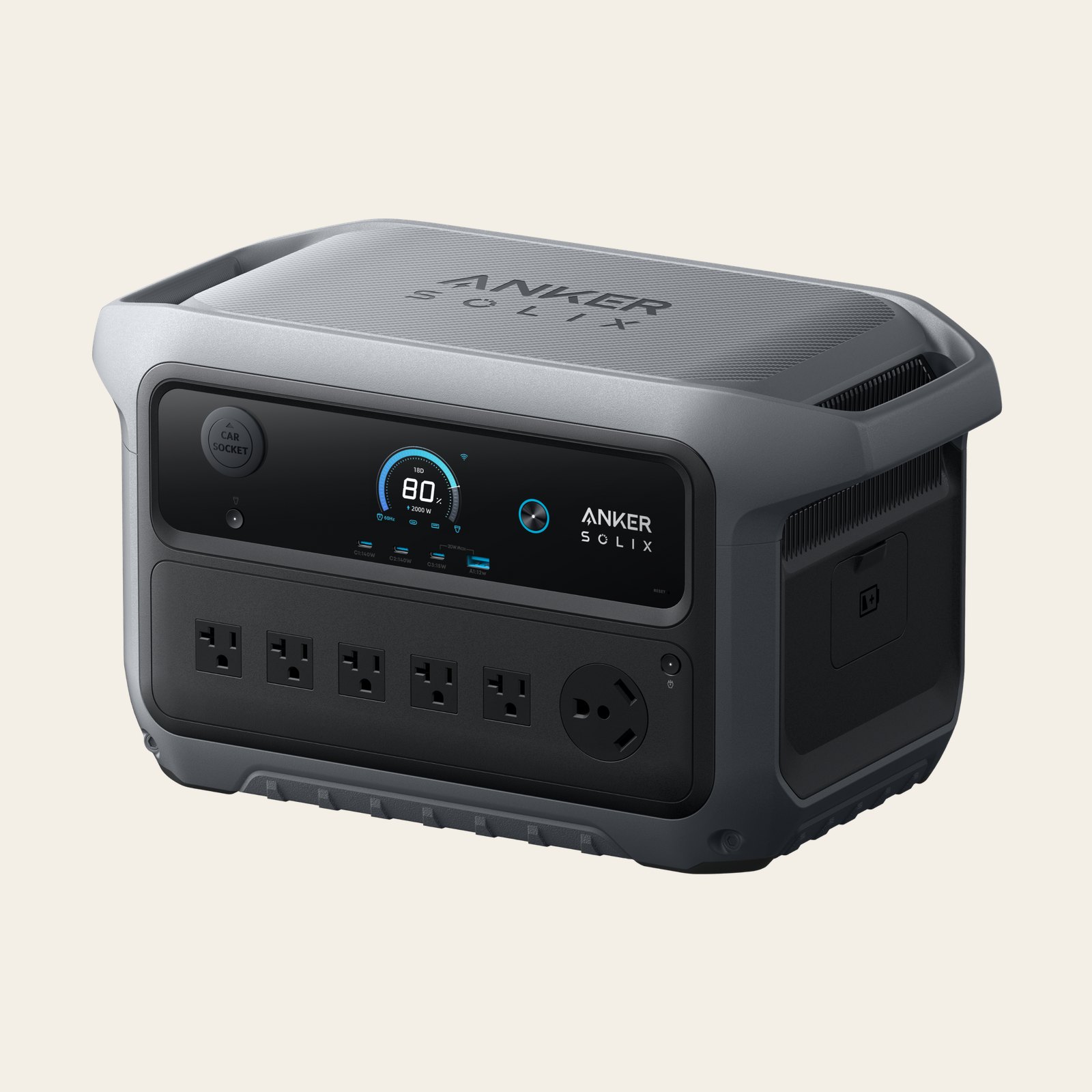
Lightest to carry
Anker SOLIX C2000 Gen 2
Twenty pounds lighter than its rivals. $899.99 and in stock on the Anker SOLIX US PDP, price-checked September 30, 2026. VERIFY-AT-PUSH: re-check ankersolix.com/products/c2000-gen2 before any deploy.
$899.99
Price checked Sep 30, 2026
See Anker SOLIX C2000 Gen 2 on ankersolix.com, opens in a new tab
Who this fits
- The station has to move (up basement stairs, into a car, down a hallway at midnight), and you’d like to do that with one hand on the railing.
- You appreciate a maker that prints its peak number (4,000 W) instead of leaving you to forums, though your own fridge still gets a calm-afternoon start check.
- Up to 4 kWh of room to grow covers your worst likely week, and you were never chasing 8,000 anyway.
- The must-list is honest 120-volt kitchen stuff: fridge, internet, lamps, a CPAP.
Who should skip
- A 240-volt well, dryer, or split-phase inlet is in the plan. That’s Anker’s own F3800 (3,840 Wh, 6,000 W, 120/240 V), a genuinely different machine.
- The whole house needs to run itself for days: standby generators.
- You want maximum steady headroom: the Explorer 2000 Plus carries 3,000 watts.
- You’re building toward a big quiet tower of 120-volt hours: the AC200L grows to 8,192 Wh.
How we know: Specification analysis of ankersolix.com.
Price check: anker-solix-c2000-gen2: $899.99 (checked 2026-09-30) (2026-09-30) — from merchant page / products.json; may change.
Limits: We did not run a hands-on lab on these units. Surge blanks stay blank where the maker never prints one clean figure. EcoFlow stays comparison-only (no hop). Disclosure mode is dormant — we do not claim commissions.
The numbers, translated
From Anker SOLIX’s US product page, September 30, 2026. Specs (2,048 Wh / 2,400 W / 41.7 lb) match the August 26 snapshot. The printed figures are copied faithfully: peak is presented as peak, never as steady output, and nothing here is borrowed from a forum.
- How much it holds. 2,048 Wh, the standard two nights of fridge for this class, because a closed fridge draws about 150 watts and only runs a third of the time. The full arithmetic, with a pencil: the buying guide.
- Steady output. 2,400 watts, tied with the BLUETTI, under the Jackery’s 3,000. Size your simultaneous loads against this number. The peak is for moments, not evenings.
- Peak. 4,000 watts, and bless them for printing it. A peak lasts about a second. It’s the shoulder that helps a compressor wake up, and it neither runs a well nor stands in for a 240-volt inverter. Spec sheet says 2,400 W steady / 4,000 W peak, checked August 26, 2026. Owners keep saying a typical kitchen fridge starts on it. Your compressor, once, in daylight, is still the check that counts.
- Weight. 41.7 pounds, against 61.5 (Jackery) and 62.4 (BLUETTI). For a station that lives on one floor, this row is trivia. For a station that travels (the stairs, the car, the in-laws’), it’s the entire purchase.
- Voltage. 120 V. If your house has a well pump, read that line twice and then go meet the F3800.
- Battery type. LFP, the same lithium-iron-phosphate family as the LiFePO4 labels on the other two, just wearing a shorter name.
- Room to grow. Up to 4 kWh: double the core, half the BLUETTI’s ceiling. Enough for a longer weekend of quiet 120-volt comfort. It was never meant to be a house plant.
- Price. $899.99 and in stock that day on the Anker SOLIX US PDP, checked September 30, 2026. Within a dollar of the BLUETTI at $899, and well under the Jackery kit (Explorer 2000 Plus + two SolarSaga 100W mini panels) at $1,429, which is out of stock on jackery.com. Against the BLUETTI, the carry and a printed peak cost about the same; they do not buy extra day-one hours. Whether that’s worth it depends entirely on your staircase, and only you know your staircase.
What it runs on a dark night lives at stations for home backup. The family comparison is at Jackery vs BLUETTI vs Anker SOLIX.
The hundred dollars and the stairs
Here’s the honest shape of the decision. If your station will live its whole life on a garage floor with a cord run to the kitchen, buy on inverter and expansion. That argument favors the Jackery’s headroom or the BLUETTI’s attic. Against the BLUETTI at $899 the price lands in the same neighborhood; against the Jackery kit at $1,429 (Explorer 2000 Plus + two SolarSaga 100W mini panels, out of stock on jackery.com as of September 30, 2026), you are comparing a carry station to a unit-plus-panels kit. But if the machine has to reach the kitchen (or a second floor, or the trunk of a car two days before landfall), the scale quietly becomes the most important spec on the sheet, and 41.7 pounds is the difference between “I’ll grab it” and “let’s wait for your brother.”
About that 4,000-watt peak: it’s a starting-watts data point, a genuinely useful one, and it still isn’t a license. Size your steady loads against 2,400 watts. The fridge that starts and the microwave that runs are occupying different seconds, and the peak covers exactly one of them. Then resist the urge to keep adding things to the pile. The station rewards restraint with hours.
One pairing note while we’re being honest about weight: Anker’s big panel, the PS400, is itself a 35.3-pound object. Panel plus station is a two-trip setup, and that’s fine, as long as you knew before buying, which is rather the theme of this site.
The F3800 belongs in a different aisle
Anker sells both machines, and we shelve them in different categories on purpose. This one is the light 120-volt station you carry to the fridge. The F3800 is the 120/240-volt cabinet (3,840 Wh, 6,000 W steady, 9,000 W surge, 132.3 lb, $2,199.98) that hooks into the house itself, legally, through an electrician. Averaging them into one score would flatter neither. A well-pump house needs the cabinet. A fridge-and-router house shouldn’t pay for 132 pounds of inverter it will never use. The full 240-volt conversation lives at the home batteries that grow.
Refilling it, and the PS400 pairing
The wall is the everyday refill. Anker’s charge-rate figures weren’t in our dated snapshot, so check the live page if a fast top-up matters to your plan.
The in-family folder is the PS400: 400 watts of daylight, sealed to IP67, $699.99 on August 26, 2026, and 35.3 pounds of honest carry. We leave its open-circuit voltage blank in our table, since Anker’s pages never settle on one figure. Confirm the station’s solar window on the live page before wiring anything clever. Twice the glass of a 200-watt folder means twice the consequence of a guessed voltage, and this is the one spec where guessing costs hardware.
Beyond that, the usual sunny-day manners apply: unfold, aim, fold before the weather turns. The rules live in the panel buying guide. The shortlist is at the panels worth unfolding · the solar category.
See Anker SOLIX C2000 Gen 2 on ankersolix.com, opens in a new tab
Price checked Sep 30, 2026
What we’re not claiming
Lighter still means 2,048 Wh on day one: 4 kWh is this family’s ceiling, not 8,192, and 4,000 peak watts is not 3,000 steady ones. There’s no warehouse of teardowns behind this page, just the maker’s printed ratings read carefully and the jobs they honestly fit. Powerwalls and rooftops live elsewhere.
If you buy after following a link here, we may earn a small commission. Your price doesn’t change. Disclosure · corrections · privacy.
If your evening loads crowd a 2,400-watt ceiling, the Explorer 2000 Plus has the room to spare. Planning past 4 kWh of 120-volt hours? That’s the AC200L’s attic, not this machine’s. And 240 volts is the F3800 no matter how good a peak number looks. But if the station in your plan ever has to be carried, and in most kitchens someday it does, get the light one. Class picture: best portable power stations · the category.