
Jackery vs EcoFlow: same tank, different inverter, one store link
People type this because EcoFlow already lives in their head from the ads, and Jackery is the cart this site will actually send them to. The tanks are a tie, about two nights of fridge. The argument is 3,000 watts of steady Jackery output versus a lighter EcoFlow box that prints a surge figure and a 6 kWh attic. Comparison only. No EcoFlow store link.

The short version
- Jackery Explorer 2000 Plus (2,042.8 Wh, 3,000 W, 61.5 lb, $1,429 kit with two SolarSaga 100W mini panels; in stock on jackery.com as of October 12, 2026, no standalone unit listed) versus EcoFlow DELTA 2 Max (2,048 Wh, 2,400 W, X Boost 3,400 W, surge 4,800 W, 50 lb).
- EcoFlow is not a featured offer, and we do not link to its store.
- Specs from jackery.com and us.ecoflow.com, September 2, 2026.
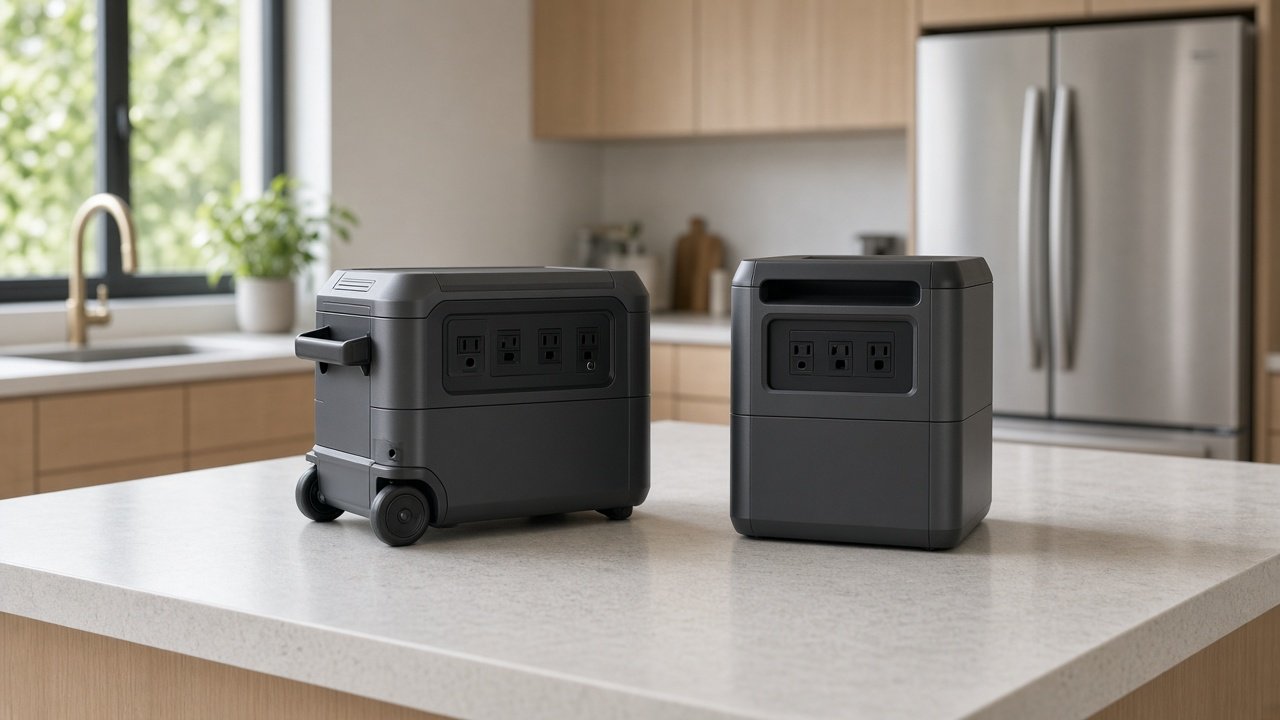
This page pairs one Jackery with one EcoFlow in the two night of fridge class: the Jackery Explorer 2000 Plus and the EcoFlow DELTA 2 Max. Not the Delta Pro. Not a Delta 3 Ultra. Those are different watt hour classes, and averaging them in would flatter nobody. Full Jackery notes stay on the Explorer 2000 Plus page. EcoFlow specs below come off the US product page on us.ecoflow.com, checked September 2, 2026. We do not keep an official EcoFlow studio photo on the shelf, so there is no product plate for that column, and there is no /go/ecoflow button anywhere on this site.
If you landed here for a fridge night and a store we actually link, our pick on the rest of the aisle is still the BLUETTI AC200L. This page is the Jackery comparison. The three family view (Jackery, BLUETTI, Anker SOLIX) is already written.
Side by side
Surge is the honest split in the table. EcoFlow prints 4,800 watts of surge and 3,400 watts of X Boost on the US Delta 2 Max page. Jackery never prints one clean surge figure, so that Jackery cell stays blank. Continuous output is the other split: 3,000 watts on the Jackery, 2,400 watts on the EcoFlow before X Boost.
| Jackery Explorer 2000 Plus | EcoFlow DELTA 2 Max | |
|---|---|---|
| Capacity | 2,042.8 Wh | 2,048 Wh |
| Continuous output | 3,000 W | 2,400 W (6 AC outlets) |
| Surge / boost | Not printed | 4,800 W surge; X Boost 3,400 W |
| Weight | 61.5 lb | 50 lb |
| Voltage | 120 V | 120 V |
| Chemistry | LiFePO4 | LFP (LiFePO4) |
| Expansion | Battery Pack 2000 Plus (named; no ceiling printed on the snapshot) | Up to two extra batteries, 6,144 Wh printed |
| AC refill | (not in our dated Jackery fields) | X Stream 1,800 W, 15 A |
| Solar input | (not in our dated Jackery fields) | 1,000 W dual port (500 W per port) |
| Street, that day | $1,429 for the kit (Explorer 2000 Plus + SolarSaga 100W mini x2); in stock on jackery.com and no standalone unit listed, checked October 12, 2026. Refurbished kits exist; we do not quote them as the featured price. | Product page listed $1,049 regular, also $1,549 and $1,449, plus an unavailable sale line and a mid September preorder note. No single cart price we will quote. |
| Where to buy here | See Jackery Explorer 2000 Plus kit on Jackery.com | None |
Jackery source: jackery.com Explorer 2000 Plus Portable Power Station, checked September 30, 2026. EcoFlow source: us.ecoflow.com Delta 2 Max portable power station, dated September 2, 2026, not rechecked on this pass. Dimensions EcoFlow printed: 19.6 × 9.5 × 12 in. Jackery dimensions were not among our dated fields, so they stay off this table.
The fridge night is a tie
Closed fridge, about 150 watts running, about one third duty cycle, a 2 kWh tank: roughly two days with the door shut. That arithmetic does not care which logo is on the case. Open the door, add a heater, or pick a garage beast, and both tanks shrink the same way. The longer night math is fridge runtime. This page will not recast it as a hold time somebody claimed after one lucky evening.
Owners keep putting Delta class boxes next to Jackery boxes for that same fridge job. Spec sheets say both inverters have room for a typical compressor start: 3,000 watts continuous on the Jackery, 2,400 watts continuous plus a printed 4,800 watt surge on the EcoFlow. Your compressor, once, on a calm afternoon, is still the check that counts.
Where they actually part
Jackery’s case is muscle now. Three thousand watts steady is 600 more than EcoFlow’s printed continuous number. Stacked 120 volt kitchen loads (fridge humming, microwave taking a turn) are the shape that number is for. It is still 120 volts. Headroom is not a second hot leg. Full notes: Explorer 2000 Plus.
EcoFlow’s case, on the dated US page, is the lighter carry (50 lb against 61.5), a surge figure they actually print, X Boost to 3,400 watts for a device, an 1,800 watt X Stream wall refill, 1,000 watts of solar input, and a printed attic of 6,144 Wh with two extra batteries. Cycle life slogans (3,000 cycles to 80%+, five year warranty) live on that page too. We copy the numbers we can date. We do not copy the slogans as tests.
X Boost is not the same claim as 3,000 watts continuous. EcoFlow prints 2,400 watts total on six outlets, then X Boost 3,400 watts for a device. Jackery prints 3,000 watts steady and leaves surge blank. Read those as two different sentences, not a winner on a blended score.
Hours later
EcoFlow prints the ceiling: two extra batteries, 6,144 Wh. Still 120 volts at any number of modules. Jackery names the Battery Pack 2000 Plus and does not print a ceiling on the snapshot we have been quoting, so we do not invent one. Extra packs buy hours. They do not buy 240 volts. The expansion map for the three featured stations (not EcoFlow) is extra batteries.
A 240 volt well, dryer, or split phase air handler is a different aisle: the Anker SOLIX F3800 or a standby generator. Neither the Explorer 2000 Plus nor the Delta 2 Max grows that second hot leg.
What the carts actually showed that day
Jackery: the featured kit is the Explorer 2000 Plus + SolarSaga 100W mini x2 kit at $1,429, checked October 12, 2026, and it is in stock on jackery.com. No standalone unit is listed. Refurbished kits exist; we do not quote them as the featured price. See Jackery Explorer 2000 Plus kit on Jackery.com.
EcoFlow: the US Delta 2 Max product page listed a regular price of $1,049, also showed $1,549 and $1,449 on the same page, marked a sale line unavailable, and carried a preorder note for mid September. We will not pick one of those figures and call it the price. Check their live page the week you buy. We still will not link you there.
$1,429 kit at Jackery, opens in a new tab
Price checked Oct 15, 2026
Who this fits
- You want the 3,000 watt continuous inverter and a store link this site actually offers.
- The station will live on a floor, 61.5 pounds, with a cord you can see.
- A named extra pack and a SolarSaga cable are the family you are willing to live in.
Who should skip
- You wanted the fridge pick we actually rank first: AC200L.
- The scale is the whole decision. EcoFlow lists 50 lb; the featured light station here is the C2000 Gen 2 at 41.7 lb.
- Anything on the must list is 240 volts. Neither of these two speaks that.
How we know: Specification analysis. EcoFlow is comparison only, with no store link.
Price check: Jackery Explorer 2000 Plus: $1,429 kit, in stock (checked October 12, 2026) (October 12, 2026): from the maker’s product page; prices change, so recheck before you buy.
Limits: We did not run a hands on lab on these units. Surge blanks stay blank where the maker never prints one clean figure. EcoFlow stays comparison only, with no store link. We do not claim commissions.
What we’re not claiming
Nobody here ran a Jackery and an EcoFlow overnight and timed the fridge. This page is two dated spec sheets plus the documented ways buyers get burned (surge versus continuous, voltage, a cart that will not load). EcoFlow is comparison only. Firmware, extra pack stock, and those EcoFlow price lines all wander. Method: how we work · corrections: contact · privacy: privacy.
We are not earning commissions from Jackery today; the Jackery link goes straight to the maker. There is no EcoFlow store link on this page. Disclosure.