
A solar generator is a battery you can plug a fridge into
Shoppers type “solar generator” when they want the food to keep. What they are usually looking at is a portable power station, sometimes with a folding panel on the driveway. Not a roof. Not a pad plant. This page is the map of that search, and then a door into the pages that actually size the night.

The short version
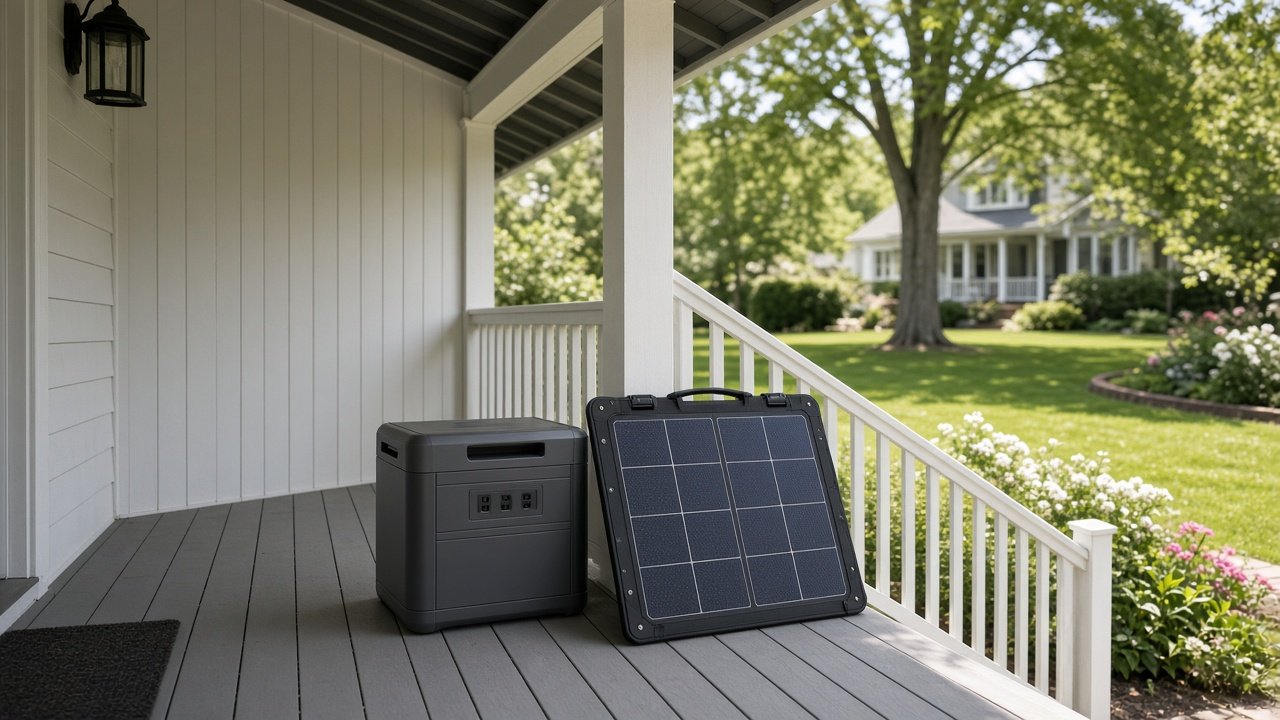
- A solar generator, in home backup shopping, is a ~2 kWh 120 volt battery with an inverter, plus a folding panel if you need daylight refill.
- The fridge math is about 150 watts at one third duty, so a 2 kWh tank is roughly two days with the door shut.
- Featured stations live under portable power stations; panels live under portable solar panels.
- EcoFlow is comparison only.
- Station prices: Jackery, BLUETTI and Anker SOLIX C2000 Gen 2 checked October 12, 2026.
The name is a leftover from camping catalogs. There is no little engine in the box. There is a lithium iron phosphate tank, an inverter that makes household 120 volt power, and, if you buy the second half of the kit, a folding panel that puts daylight back into the tank. Owners keep saying they bought one for the fridge and the WiFi. Spec sheets in this class print about 2,048 watt hours and 2,400 to 3,000 watts of steady output, checked September 30, 2026. That is the whole product, once you strip the word “solar” down to what it actually does.
It does not replace a roof. If an installer is already measuring yours, you are on the wrong site, and we would rather say that in the first screen than waste the evening. It also does not replace a standby generator when the well pump, the furnace, and three days of ice are on the must list. Those are different machines. The solar generator search is the quiet indoor one: fridge, router, lamps, maybe a CPAP, a cord you can see.
The two piece kit, named honestly
Piece one is the station. Piece two is the panel, and only if the outage can outlast one tank. A four hour evening with the grid down is a battery problem. A long weekend with decent sun is where the glass earns its keep. Mix those two jobs up and you either skip a panel you needed, or you buy 35 pounds of driveway kit for a storm that always ends after dark.
On this desk the station lives at portable power stations. The panel lives at portable solar panels. This hub does not clone those product pages. It tells you which door to open, and why the search term led you here.
Fridge math, not a lab story
A closed refrigerator draws about 150 watts and runs maybe a third of the time. Put that against a 2 kWh tank and you get roughly two days. Add the internet and some lamps and you are still in tomorrow. Add a 1,500 watt space heater and the tank is an evening. Owners keep saying the compressor start is the moment that worries them; spec sheets in this class print 2,400 to 3,000 watts of continuous output, which is a lot of room for that spike. Your own fridge, once, on a calm afternoon, is still the check that counts. The longer version of the night itself is what a station really runs. The pencil math is the buying guide.
Which station, without repeating the product notes
Three machines do this job here, and the first one to name is the one that fits the fridge and CPAP night: the BLUETTI AC200L (2,048 Wh, 2,400 W, 62.4 lb, $899 and orderable at bluettipower.com/products/ac200l, with 2 to 5 business day delivery, checked October 12, 2026). It is our pick on this page because the attic is printed: extra batteries up to 8,192 Wh, still 120 volts. Full notes: AC200L.
The carry is the Anker SOLIX C2000 Gen 2 (2,048 Wh, 2,400 W, 4,000 W peak, 41.7 lb, $999.99 with a code that expires January 1, 2027 (base price $1,199.99), checked October 15, 2026; in stock on ankersolix.com when checked October 15, 2026). Twenty pounds lighter than the other two. Stay on Anker SOLIX, not Anker.com retail. If the house later needs 240 volts, that family’s answer is the F3800, a different machine on a different page.
The strong inverter is the Jackery Explorer 2000 Plus (2,042.8 Wh, 3,000 W, 61.5 lb, $1,429 for the kit with two SolarSaga 100W mini panels, in stock on jackery.com, checked October 12, 2026). It sits in the 2 kWh comparison, not as our default pick. No standalone unit is listed on jackery.com’s product page; only the Explorer 2000 Plus + SolarSaga 100W mini x2 kit, at $1,429 and in stock (checked October 12, 2026). Refurbished kits exist; we do not quote them as the featured price. See Jackery Explorer 2000 Plus kit on Jackery.com.
Job by job assignment of those three lives at the stations we’d buy. Family versus family (extra packs, panel cables, the 240 volt fork) is Jackery vs BLUETTI vs Anker SOLIX.
The panel, only if you need the second day
Daylight refill is a voltage problem dressed up as a shopping problem. Open circuit voltage has to sit under the station’s solar maximum, with margin for a cold bright morning, which is when voltage climbs. Stay in the family cable: SolarSaga into Jackery, SP200L into BLUETTI, PS400 into Anker SOLIX. The SP200L is the one whose maker prints Voc plainly (24.6 V). The other two leave that cell blank on our tables because the manufacturer pages never settle. The shortlist: the panels worth unfolding. The lecture: panel buying guide.
Renogy shows up in owner threads as a panel add on, especially when someone already owns a station and wants extra glass. It is not a featured link here. If the cable and the Voc window both check out, it can be a later accessory. It is not the default kit on this page.
What this search is not
- A rooftop array. Permits, rails, an installer. Out of scope. About says so in one sentence.
- A Tesla Powerwall. Different product, different site.
- A 240 volt well or dryer. Extra solar generator batteries never grow the missing hot leg. That is the F3800 or a standby generator.
- A transfer switch install by itself. Cords you can see are the default for this class. The three paths: cords, inlet box, or automatic transfer switch.
This hub is your search if
- You typed solar generator and meant the fridge, not the roof.
- The must list is 120 volt and indoor quiet.
- You will size the tank first and add a panel only if the outage can last past one charge.
Your search lives elsewhere if
- The whole house has to run itself: generators.
- A 240 volt load votes: home batteries.
- You already know you want a station and just need the night map: for home backup.
Also in the aisle, not on the cart
EcoFlow. Comparison only. The hardware is real, and owners keep putting Delta class boxes next to these three. The dated pairing is Jackery vs EcoFlow. It is not a featured offer. No EcoFlow store link here.
Under 1 kWh “solar generators.” Fine for a phone and a lamp. Ask one to hold a refrigerator overnight and the tank is a short story.
Featured store links: See BLUETTI AC200L on bluettipower.com, See Anker SOLIX C2000 Gen 2 on ankersolix.com, and See Jackery Explorer 2000 Plus kit on Jackery.com. We are not earning commissions from these brands today; store links go straight to the maker. Disclosure.
This page is a map of a search term, not a teardown. Specs and street prices come off the makers’ US pages. Specs were checked September 30, 2026, with the August 26 spec snapshot still standing where a figure did not move. Jackery, BLUETTI and Anker SOLIX C2000 Gen 2 prices checked October 12, 2026. Method: how we work · corrections: contact · privacy: privacy.